EVIL

I’ve been thinking about evil.

I got on this track chatting to Sarah about David Lynch for her screening of Fire Walk With Me with htmljones. Then chatting with my girlfriend Catherine about the protest chant ‘[insert politician] see you in The Hague!’ How the satisfying end word skews so close to see you in Hell! Wanting some earthly reckoning for evil deeds. I find myself calling it evil. Looking at Keir Starmer, David Lammy, the more full throated rhetoric of the Israeli government and its genocide of Palestinians. Evil. I’m not religious, but I’m sure I’ve inherited some Catholicism. No Catholicism tho (in the tone of no homo) I don’t want to be part of this weird new wave. Catholicism is not cool tbh (although obviously don’t be Protestant!!!) and trans people need to stop becoming altar boys etc imo (is this a thing? I assume so) Then again I don’t want to swing too far and end up all Richard Dawkins New Atheist (some say this is one of the predecessors of the (evil?) Terfism plaguing this (evil) island - whereas woke pope did eat pasta with the dolls so, much to consider).

I watched the film Evil Does Not Exist with my pal Charlie (producer of Hormonal) recently and it reminded me of attending zoom consultations for planned new developments in my hometown during Covid. The original plan, laid out by an (evil) Labour councillor, was to bulldoze half the town centre and throw up multi story flats - with the aesthetics of a luxury development. I’m so used to being against luxury flats that I was reminded by aforementioned gf that we should WANT nice flats! And the luxury flats that are built are usually not even that nice or big, they are just expensive. A friend told me they walked around the hallways of one of the horrid new-builds in Elephant and Castle (RIP - evil) and all of the letterboxes were clanging around because the wind whipped right through the building. It’s not luxury, I remind myself to refuse their branding. A cgi (now ai probably) rendering of a yuppie fantasia on a slice of hoarding does not luxury make.
Anyway, I was peripherally part of a campaign against this planned gutting of the town centre. We faced much talking down from various Basildon political figures, (including a Tory who addressed me as Young Man and thought we’d find it encouraging when he said back ‘home’ in Northern Ireland he’d be in the DUP) held our own meetings, canvassed, stood anti-redevelopment candidates (who got a respectable portion of votes!) In the end, tories won over Labour in the local elections with promises to scrap the plan. Years later, parts of it are still going ahead. Colourful murals cover buildings soon to be pulled down, courtesy of a carpetbagging arts initiative.
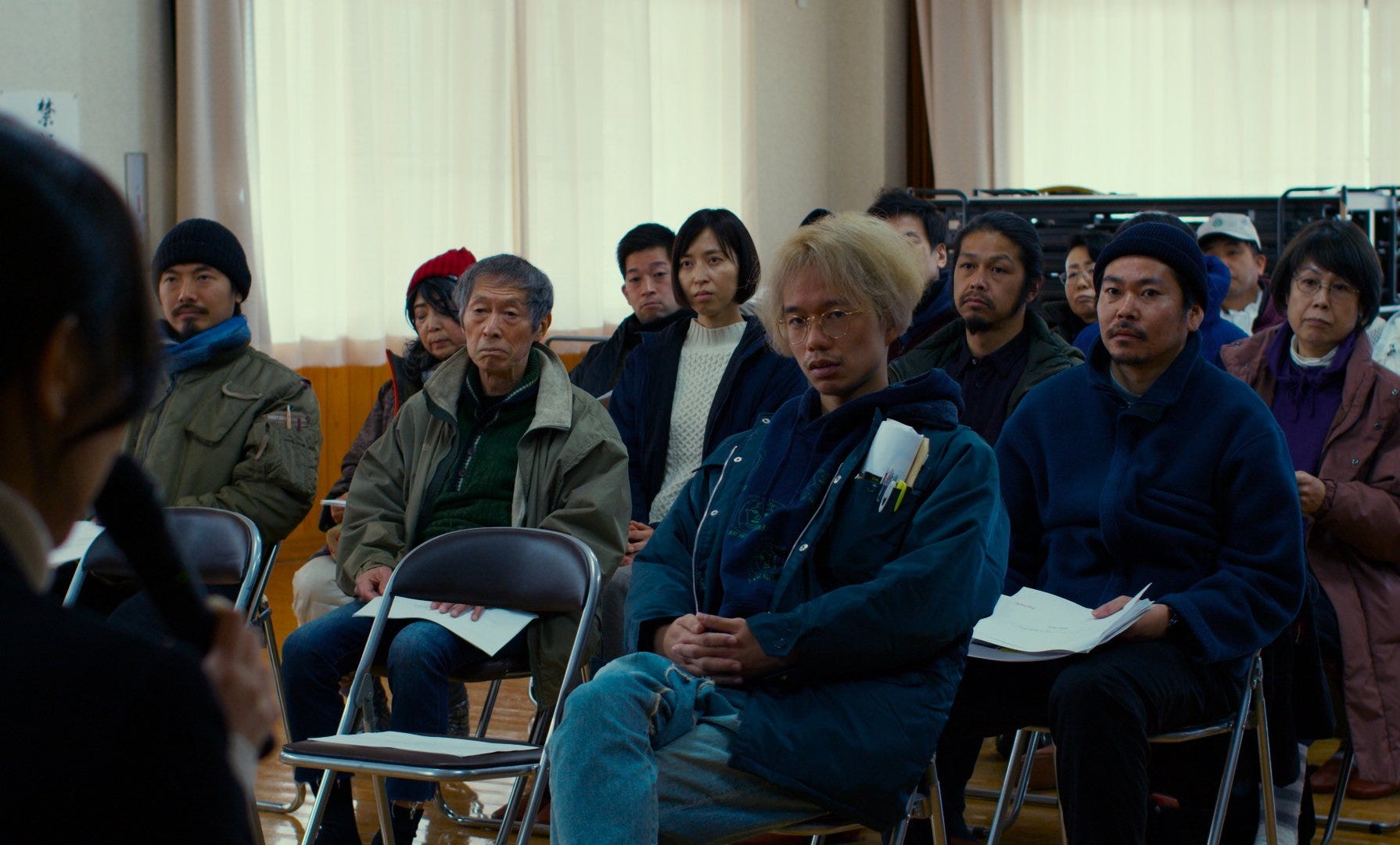
In Hamaguchi’s film, the intentionally futile performance of a public forum gives way to a fable-like moment of undeniable manual brutality. Overall the movie left me cold but the ending stuck with me - maybe it did reveal that famous evil behind the banality of a town hall meeting, a public consultation. Having a consultation to discuss doing something evil, which you are going to do anyway. It’s this seedy sheen that makes me want to call evil re: figures like Lammy. I get a bitter taste in my mouth thinking about his instrumentalising of grief around Grenfell for his personal brand, and his current unrepentant bloodlust, his imprisonment of Pal Action protesters, letting them starve.
I heard Nick Smith speak of his work, partially inspired by his job as a property inspector, for a sharing at Studio Voltaire. When speaking about class and the built environment he quotes, and notes its potential for controversy, a phrase from John Cooper Clarke: “Never mind what’s going on in Nairobi, concentrate on what your local council are doing”. It made me think of the ways I try to make political change on my own small (rented) patch of soil, how Zelda spoke of battling Basildon council to grow the grass at the local park a few biodiverse inches taller. If we can’t control the grass in our own park, what hope have we globally? she asked at a Directions Bas event. And yet - the Labour councillor unseated by his Basildon tower block hubris ended up doing (probably evil) development deals in Africa between his stints in local government. People in the imperial core have always been intimately entangled with the Global South in mundane (evil) ways. When I researched pantomime for Principal Boy, I read about Victorian pantos that dramatised real battles in India, featured imaginary African tribes holding signs saying ‘Hi Mother!’ to the Queen.
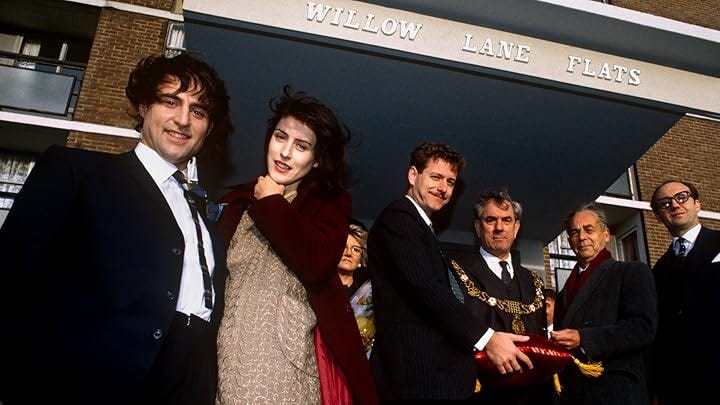
More recently, I watched Industry and the episode in Accra almost made me think I understood business - and then I finally finished watching Our Friends in the North, thanks to a very stubborn flare up. In the 1996 tv serial, the Labour Party cosies up with a development company to throw up substandard flats in Newcastle, which grow black mould. The company is then allowed to swan off round the world, obtaining contracts for buildings in Saudi, across former British colonies. The council foots the bill for the Newcastle flats to be refitted and people rehoused, only after years of pressure.
I’m thinking about evil because I’m also thinking about the devil. He(?) keeps cropping up in an idea for a film I’m working on, and I worry it’s a big thing to take on. One of thee original IPs. What do I think of him(?) is he(?) a trickster, misunderstood? What does a deal with the devil entail? One such contemporary trans take on this classic is Grace Byron’s Herculine, where (SPOILER!!!!!) trans women on a separatist commune get shortchanged by their deals with demons, which turn out to be something of an MLM run by the HBIC Ash, the nameless protagonist’s ex-girlfriend. Of course, the devil would outsource!
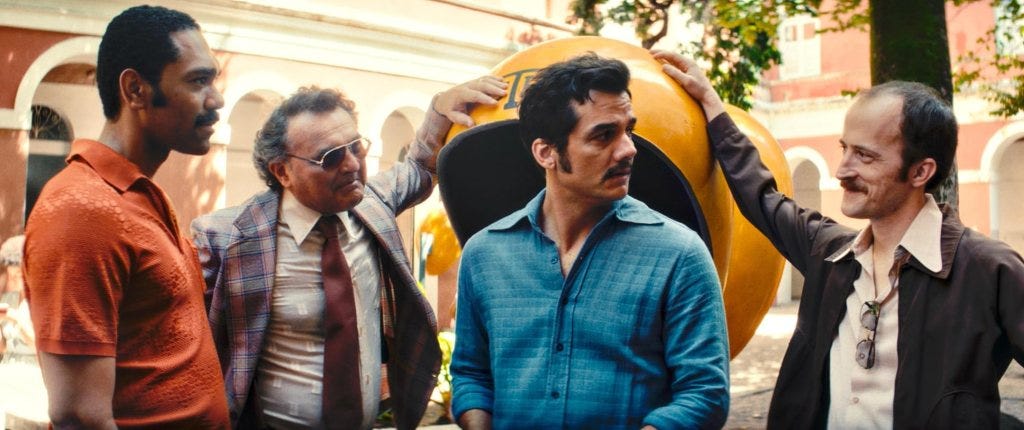
Such outsourcing recalls parallel scenes in The Secret Agent (also SPOILER!!!!) the first: a businessman haggles with two hitmen, ending back at the price (60000) he started. Later, the hitmen haggle with a labourer and task him with their dirty work. He stays firm in his price (a lowly 4000) and even kills his outsourcing employer (hurrah!!) before (we assume) he or someone else finishes the job off screen, landing with a dull thud, a newspaper article on the computer screen of a contemporary researcher.
Is the English devil sleek in a consultancy way or is he a Reform small business owner brawler? Is he the horrific combination of the two - the posh boy in downward drag? The true brute? Do I have to read the bible? I do want to get round to it. I’ve read sections and I admire its pacing - rapid! But I already stated my queasiness around religion. Am I scared of invoking the wrong thing, or accidentally summoning Lucifer himself!?
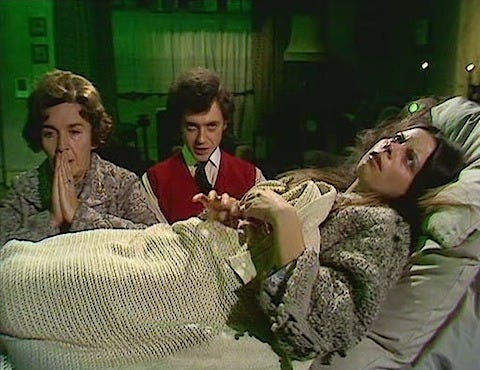
In my research I watched two versions of Dennis Potter’s Brimstone and Treacle. Both are striking and unnerving, but the 1982 Sting version takes out much of the political message of the original 1976 Play for Today, which went unaired til 1987 because it was deemed too disturbing. I stroke my chin at this because the sexual violence in the 1982 version is arguably more graphic and includes nudity. Briefly, (SPOILER!!!!!) Brimstone and Treacle follows a demon in the guise of a young white man who inserts himself into the home of a middle class north London suburban couple whose daughter Pattie has a kind of unresponsive wakefulness syndrome after a car accident. She requires constant at-home care. He rapes her. The demon worms his way into the hearth of this English home through quickly spinning a line that he was a potential fiance to their daughter Pattie. The mother is quick to go along with his story - the notion of Pattie in bed, paralysed, while her mother imagines her wedded off to the demon, strike at the deep seated sexism and ablism of the time. In the Play for Today, he takes a different tack in seducing the father. This version includes characterisation of the father as a National Front member, cracking anti black and anti Irish jokes. The demon laughs along with him and leads him further to the conclusion of his politics - the deportation and, if this doesn’t ‘work’, genocide of Britain’s Black population. The father dithers and stammers, says steady on a minute.
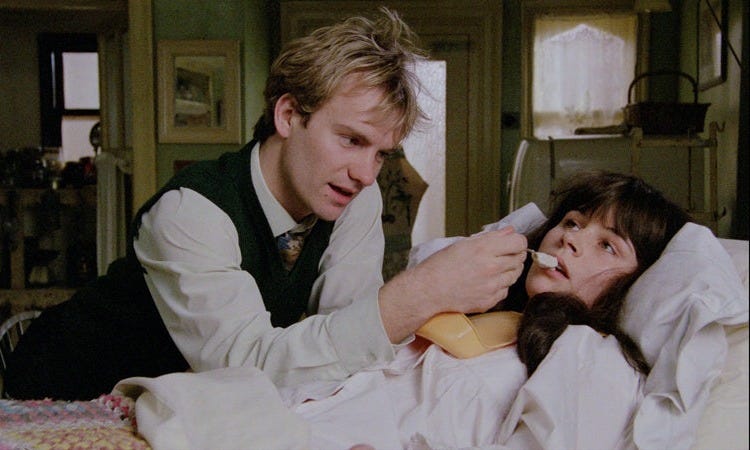
Potter pairs well with Lynch, that other big daddy of Evil™️. Lynch has a reputation for political ambivalence, even Reaganism. On my recent Twin Peaks and Fire Walk With Me rewatch, I found myself surprised at how many overt instances of political rhetoric I encountered. There’s his slightly hamfisted defence of Indigenous Americans’ right to their land, the evil of the white man. There’s the famous ‘Fix your hearts or die’ line at the defence of (regrettably) super cop Denise. There’s the evil lurking in the heart of the American nuclear family in Leland Palmer/BOB. Watching again, I agree that characterising this as demonic possession is a canny way to tell a survivor-centered story, and whatever mistakes made in the series are rectified in Fire Walk With Me. In the end, Laura is with the angels (there’s religion again - beige middle America Protestant aesthetics rendered sublime). Pattie, perhaps miraculously, exits her paralysis to alert her parents of her assailant, and remember her father’s hypocrisy. There are no angels, just a tacky picture of Jesus - but divine intervention is implied. I’m not Rosalia or Bjork, I think it’s up to us - but I do see the appeal! In Twin Peaks The Return, Lynch spends a lot of time outlining the post recession decline of the iconic small town USA he created those decades before. Key moments of garmonbozia occur on a housing development full of identikit beige bungalows - desolate. The business decisions, the zoom consultations, the corruption that magicked them into being hum off screen like the score. Laura Palmer screams. She wasn’t with the angels after all.
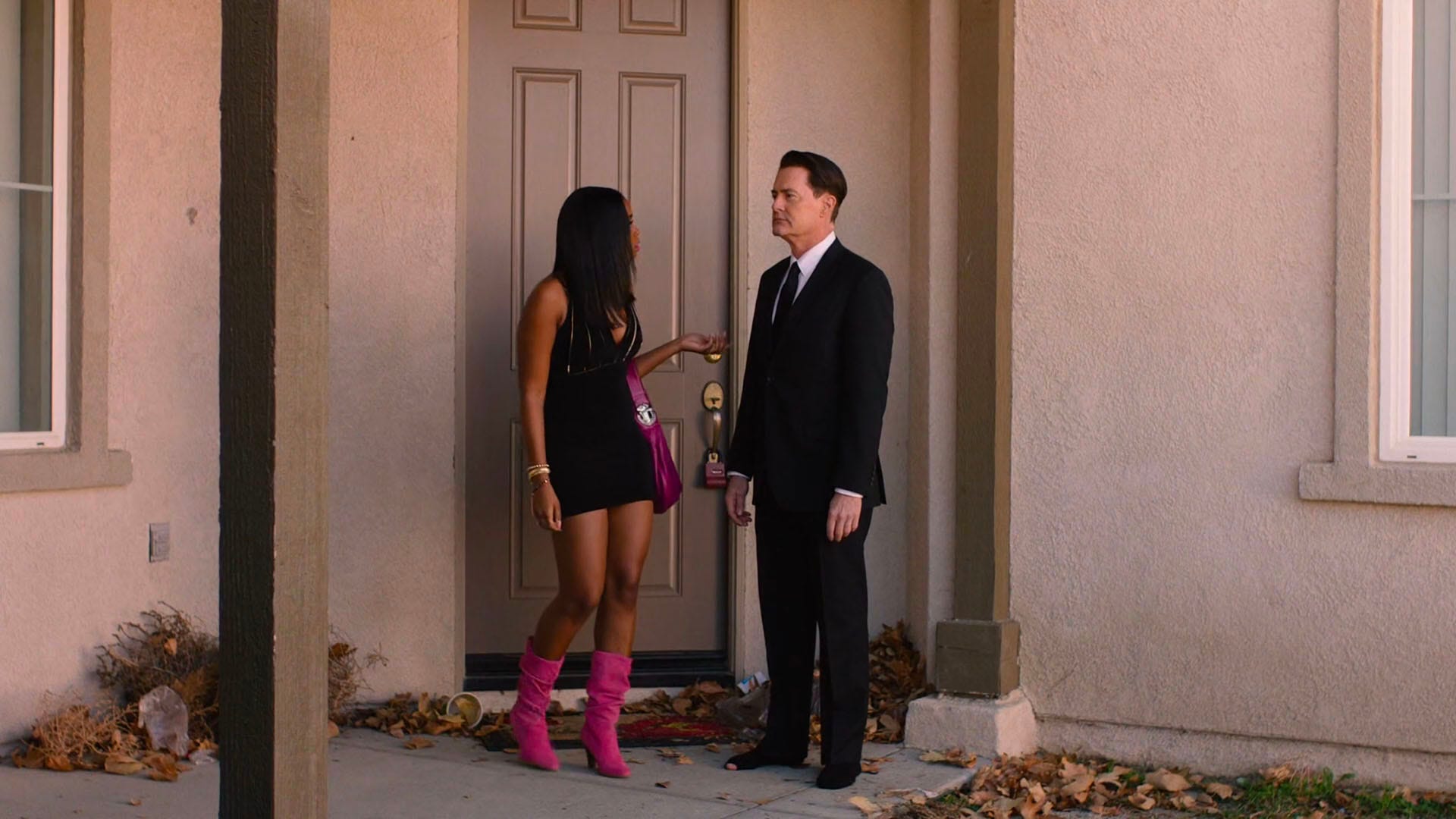
Like Fire Walk With Me, Brimstone and Treacle is not subtle. In Jennet Thomas and Sally O’Reilly’s episode of ART FICTIONS podcast, (side note: come to BIG THROW on April 23rd, Sally and Jennet’s event at SET Social) they point to the significance of the demon swinging his feet out of bed in the morning and landing hairy and gnarled on the 70s thick pile carpet. Someone else would not do this. Someone else would be subtle, hint at it. But what use is good taste in the face of evil?
This brings me back to thoughts of Palestine and Mohammed el Kurd’s Perfect Victims, on the way brushing against an antisemitic trope when discussing the actions of the Zionist entity is taken more seriously than the ACTUAL (EVIL) the Zionist entity is doing. Rhetoric is taken literally (do you want to throw Israelis in the sea?) action is erased from the narrative (the literal slaughter of thousands of Gazans). It’s absurd in the way (evil) can be.
In Night Night Fawn, Jordy Rosenberg tooled himself with satire in the quest to meet a certain kind of Zionism where it lives. Not the rabid kind, the endemic uneasy kind. He wants to match absurdity with absurdity. We’re at the whims of an oppressive first person narrator - Barbara Rosenberg, a staunch homophobe who once lived in an apartheid state and sent her child to its army for gender correction (crazy move - butch lesbians are addicted to joining the army, the police & Donald Trump’s security team). In the vein of Jonathon Swift, we stay inside the absurdity of evil and the oppressor class (Rosenberg as a White American Jew, Swift as an Anglo-Irishman), deepened by the knowing humour of a trans person writing a trans/homo/phobe. It’s funny rather than grueling - perhaps its true power lies in its broader audience, those on the Barbara Rosenberg continuum.
Satire and absurdism are forms I also find myself turning to - at least that’s what my artist statement says.
Recently, I made a film with Whitechapel Gallery’s youth collective Duchamp and Sons. Over the course of 4 months, we experimented with different film and performance techniques then condensed our ideas and shot something. The idea bubbled up into a media satire. Alan Partridge was name checked. The collective spoke of the high drag of right wing news presenters. At first I was surprised - these gen alpha kids watch the news?? I don’t! Then I remembered maybe there is still a monoculture. TVs play the news in cafes salons pubs homes across the country. Taxi/uber/bolt drivers mainline LBC. Bits are clipped and reposted on TikTok (probably - I am too old to use it I decided, which is sad because part of me thinks I’d be really good at it) the young people were adept at the tone deployed by hacks from the BBC and GB news. At first I had trepidation about using broad satire alongside earnest engagement with the issues we’d talked about - Palestine, Sudan, Venezuela, housing crisis, protest restrictions, censorship, cost of living crisis, artists pay. But - what can I and Whitney Houston say - the children are the future. Making the film challenged me to think about the balance of satire and sincerity in my own work. What am I actually satirising? Is the humour endearing my target? Is it too obvious? Is it too obscure? Is there actual heart, blood sweat and tears in this or am I floating above it looking through a monocle and saying ‘I say!’
Last year I had an aesthetic crisis (if I told you about my aesthetic crisis last year you may be eligible for compensation). I was fretting over whether my work was meaningful in the face of such politically dispiriting (rise of fascism, genocides across the world) and mobilising (the Palestinian struggle, the solidarity shown by workers across the world, the left movements less bedraggled than the UK’s) times. I also thought fuck it my art is not activism does it need to mean anything, in fact perhaps it shouldn’t have to mean anything, how do I make sure it is meaningless despite being an Identity Haver™️, and I swang from one extreme to the other til I was snapped tf out of it by my collaborators Munesu and Bri. Then I accidentally made work that was still very clearly about being trans. But that’s a story for another day…
Come up and see me sometime:
Go see a DVD of my film works at 123 movies exhibition, 243 LUZ, Margate until 18th April
Mica Georgis’ performance night at the Florence Trust 24th April
Jaw Filler extracts & links:
P.S. All thanks to Adwoa Owusu-Barnieh, wonderful assistant civic curator at Studio Voltaire, for reminding me of the faggy powerpuff girls devil